


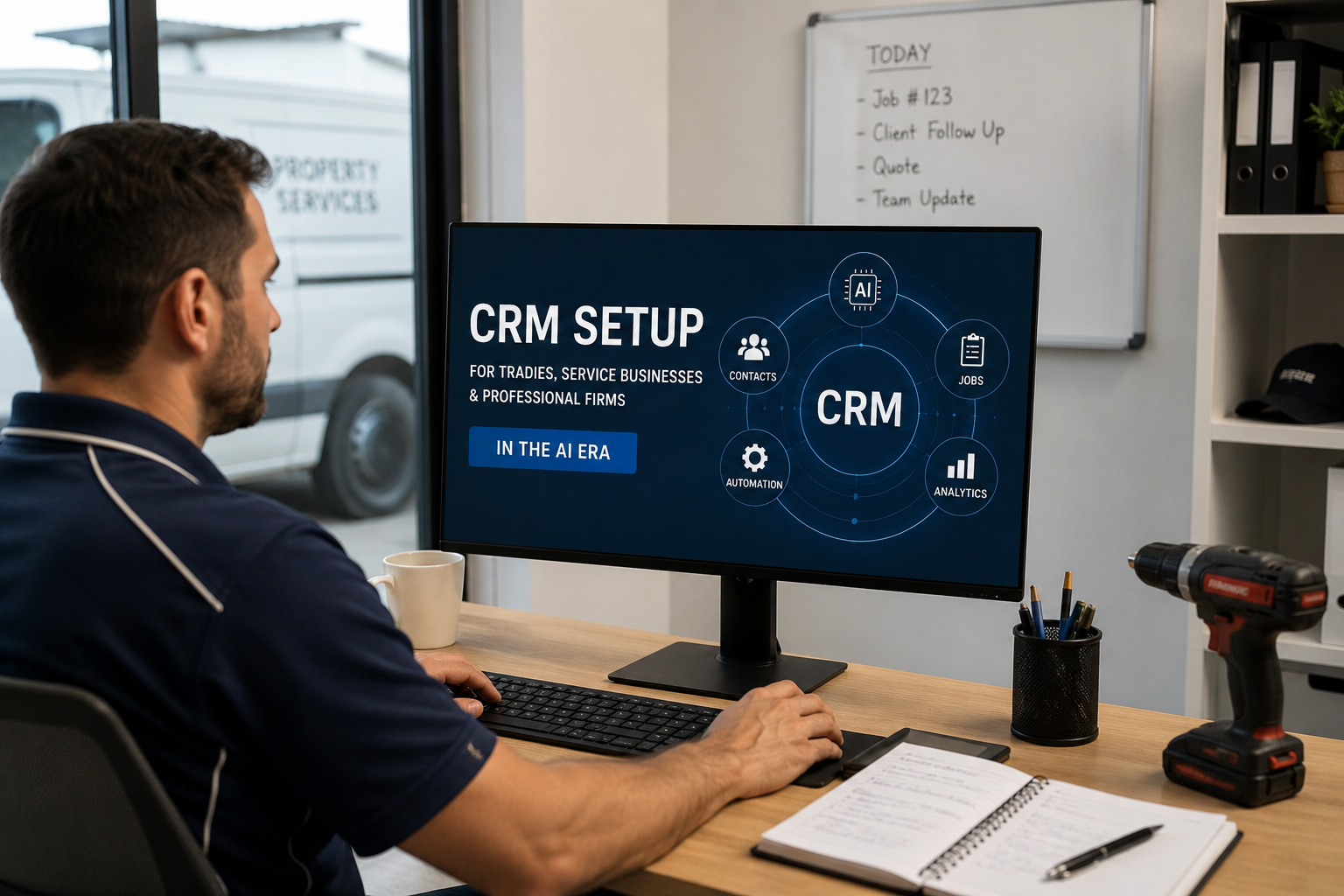
The Ultimate Guide to CRM Setup for Tradies, Service Businesses and Professional Firms in the AI Era
Why Having a CRM Is More Important Than Ever
Artificial Intelligence is rapidly changing the way businesses attract leads, communicate with customers, manage sales opportunities, and deliver services.
AI-powered chatbots answer enquiries 24/7.
Automated follow-up systems nurture prospects.
Smart workflows reduce administration.
AI assistants generate content, emails, proposals and customer communications.
Yet despite all the excitement around AI, many business owners are overlooking one critical fact:
AI is only as good as the data it can access.
For tradies, service businesses, consultants, accountants, mortgage brokers, financial advisers, lawyers, healthcare providers, and professional service firms, that data should live inside a properly structured CRM.
Your CRM is no longer simply a contact database.
It has become the operational command centre of your business.
Every lead, customer interaction, appointment, quote, proposal, invoice, email, text message, review request, follow-up sequence and AI-powered automation relies on the information stored within your CRM.
If your CRM is disorganised, incomplete or poorly configured, AI cannot deliver the outcomes you expect.
Poor CRM data creates:
- Missed opportunities
- Inaccurate reporting
- Poor customer experiences
- Broken automations
- Inefficient workflows
- Lower conversion rates
- Lost revenue
In contrast, businesses with structured CRM systems are increasingly leveraging AI to create competitive advantages that were unimaginable just a few years ago.
The reality is simple:
Before you can build an AI-powered business, you must build an AI-ready CRM.
Why Service Businesses Need a CRM More Than Ever
Many service businesses still operate using a combination of:
- Email inboxes
- Excel spreadsheets
- Paper notes
- Job management software
- Individual staff memory
- Multiple disconnected applications
This approach creates significant risks.
When information lives in multiple locations, businesses lose visibility.
Leads are forgotten.
Follow-ups are missed.
Customer histories disappear.
Staff become dependent on tribal knowledge.
Growth becomes difficult to manage.
A CRM centralises information into a single source of truth.
Every interaction becomes trackable.
Every lead becomes visible.
Every opportunity becomes measurable.
Most importantly, your CRM becomes the foundation for automation and AI.
Why We Recommend Go High Level
At DigitalxMarketing, we have evaluated numerous CRM and marketing automation platforms.
Our preferred solution is Go High Level (GHL), which powers our DxM Marketing AI platform.
The reason is simple.
Most businesses require multiple systems to manage:
- CRM
- Email marketing
- SMS marketing
- Website forms
- Appointment scheduling
- Sales pipelines
- Workflow automation
- Reputation management
- AI tools
- Reporting
Go High Level brings these capabilities together under one platform.
However, simply purchasing software does not solve business problems.
Success depends on how the CRM is structured.
The Foundation: Contact Management
The first step in building an effective CRM is designing your contact database correctly.
Many businesses simply import contacts without considering future segmentation.
This creates problems later.
Every contact should contain relevant information including:
Basic Information
- Name
- Company
- Mobile number
- Address
- Website
Business Information
- Industry
- Business size
- Revenue range
- Service requirements
Lead Source
Where did the enquiry originate?
Examples include:
- Google Search
- Google Ads
- Referral
- Website enquiry
- Email marketing
- Networking
- Existing client referral
Knowing your lead source is essential for future reporting and AI-driven analysis.
The Importance of Segmentation
One of the biggest CRM mistakes is treating every contact the same.
Not every customer is equal.
Not every prospect is ready to buy.
Not every lead requires identical communications.
Segmentation allows you to group contacts based on meaningful criteria.
Examples include:
Customer Type
- Residential
- Commercial
- Government
- Corporate
- Non-profit
Service Type
- Plumbing
- Electrical
- Accounting
- Financial Advice
- Legal Services
- Digital Marketing
Customer Status
- Prospect
- Active Client
- Previous Client
- Referral Partner
- Supplier
Engagement Level
- New Lead
- Warm Prospect
- Sales Opportunity
- Proposal Sent
- Existing Customer
Effective segmentation dramatically improves marketing performance and customer engagement.
Designing Your Sales Pipeline
Every service business should have a clearly defined sales pipeline.
A pipeline provides visibility into where prospects sit within the customer journey.
A typical service business pipeline may include:
Stage 1: New Enquiry
A prospect submits an enquiry through:
- Website
- Phone
- Social Media
- Referral
Stage 2: Contact Attempted
Your team makes initial contact.
Stage 3: Discovery Meeting Booked
A consultation or site visit is scheduled.
Stage 4: Proposal or Quote Sent
A formal proposal is delivered.
Stage 5: Follow-Up
The prospect is considering options.
Stage 6: Won
The prospect becomes a customer.
Stage 7: Lost
The opportunity is closed without proceeding.
This structure provides accurate forecasting and reporting.
Building a Customer Lifecycle Pipeline
Many businesses stop managing customers once a sale is completed.
This is a mistake.
Your CRM should also manage the customer journey.
Example customer lifecycle stages include:
Onboarding
Customer becomes active.
Service Delivery
Work is underway.
Project Completed
Work has been delivered.
Review Requested
Automated review requests are sent.
Upsell Opportunity
Additional services are offered.
Renewal or Repeat Service
Customer returns for future work.
Referral Programme
Happy customers become referral sources.
This approach maximises customer lifetime value.
Automation: Where the Real Power Begins
A CRM should reduce administration.
Automation allows businesses to create consistent customer experiences while reducing manual effort.
Examples include:
Lead Response Automation
Immediately acknowledge enquiries.
Appointment Reminders
Reduce no-shows.
Proposal Follow-Ups
Automatically remind prospects about outstanding quotes.
Customer Onboarding
Deliver welcome information automatically.
Review Requests
Increase online reviews.
Re-engagement Campaigns
Reconnect with inactive customers.
Renewal Reminders
Generate repeat business.
The goal is not to remove human interaction.
The goal is to ensure important tasks never get forgotten.
Preparing Your CRM for AI
Once your CRM is properly structured, AI becomes significantly more valuable.
AI can then:
- Analyse customer behaviour
- Predict future opportunities
- Generate communications
- Summarise conversations
- Recommend actions
- Improve customer service
- Enhance lead nurturing
- Create personalised marketing
However, AI cannot fix poor data.
If customer information is inconsistent, duplicated or incomplete, AI will simply amplify those problems.
This is why CRM structure must come first.
Questions Every Business Owner Should Ask
If you are unsure whether your CRM is properly configured, ask yourself the following questions:
Lead Management
- Do all enquiries automatically enter the CRM?
- Can I see every lead in one place?
- Do I know where every lead originated?
Sales Process
- Do I have clearly defined pipeline stages?
- Can I forecast future revenue?
- Can I identify bottlenecks?
Customer Management
- Can I see every customer interaction?
- Is customer information complete and accurate?
- Are customers segmented correctly?
Marketing
- Can I send targeted communications?
- Can I automate follow-ups?
- Can I track campaign performance?
Reporting
- Do I know my conversion rates?
- Do I know my cost per lead?
- Can I accurately measure ROI?
AI Readiness
- Is my data clean?
- Is information standardised?
- Can AI access meaningful customer information?
If the answer to several of these questions is "No", your CRM likely requires attention.
Common CRM Mistakes We See
At DigitalxMarketing, the most common issues we encounter include:
- No pipeline structure
- Duplicate records
- Poor segmentation
- Incomplete customer data
- Broken automations
- Lack of reporting
- Generic templates
- No documented customer journey
- No AI strategy
These issues typically become more expensive to fix as businesses grow.
How DigitalxMarketing Helps Businesses Build AI-Ready CRM Systems
Our DxM Marketing AI platform, powered by Go High Level, is designed specifically for growing service businesses.
We work closely with clients to:
- Design CRM architecture
- Configure pipelines
- Create automations
- Build reporting dashboards
- Implement AI tools
- Improve customer journeys
- Increase lead conversion
- Support long-term growth
Most importantly, we customise the system around how your business actually operates.
Because every business is different.
A plumbing company does not operate like an accounting practice.
A law firm does not operate like a digital agency.
A mortgage broker does not operate like a healthcare provider.
Your CRM should reflect those differences.
Final Thoughts
The future of business is increasingly automated and AI-driven.
But AI is not the starting point.
Data is.
And for most service businesses, tradies and professional firms, that data lives inside the CRM.
Businesses that invest time in building a structured, organised and scalable CRM foundation will be the ones best positioned to benefit from AI, automation and future technologies.
Those that continue relying on spreadsheets, disconnected systems and incomplete customer records will struggle to keep pace.
If you want better leads, better customer experiences, improved reporting and successful AI implementation, start with your CRM.
Because the quality of your AI will never exceed the quality of your data.
About DigitalxMarketing
DigitalxMarketing Ltd is an AI Marketing Agency and business growth consultancy helping B2B and small to mid-sized businesses attract, convert, and retain more customers using intelligent marketing systems and automation. We developed DxM Marketing AI, our all-in-one AI marketing operating system that combines CRM, lead generation, sales pipelines, email and SMS marketing, websites, marketing automation, reputation management, analytics, and AI agents in one powerful platform. We provide full onboarding, training, and ongoing support so you can run your own marketing in-house, or we can deliver everything for you as a fully managed marketing and sales engine. Our services include AI-powered marketing systems, SEO, paid advertising, email marketing, content marketing, sales funnels, CRM, chatbot and AI agent deployment, and fully managed digital marketing.